The problem: a safety fix that can become a barrier
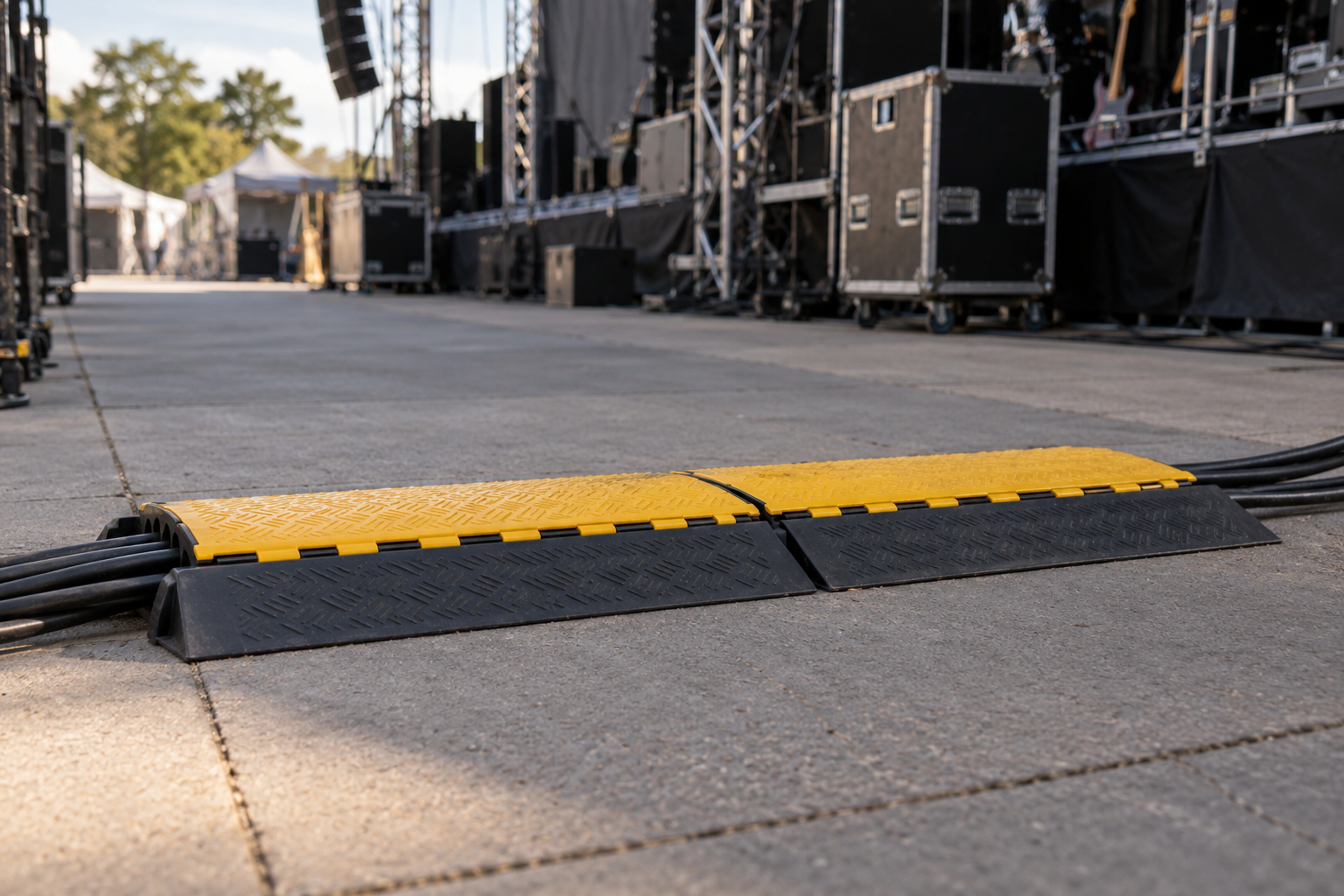
Every outdoor show and many indoor ones run power, audio and lighting cables across ground that people also walk on. Ramps and protectors reduce concert cable trip hazards and shield feeders from foot traffic and carts. The difficulty is that the protector is itself a raised object. A guest walking carefully may step over it without thinking, but a guest using a wheelchair, a walker, crutches or a mobility scooter meets it as a change in level and has to cross it.
The US Department of Justice publishes the 2010 ADA Standards for Accessible Design, which address accessible routes, changes in level and ramps as parts of how a route is designed [S1]. The Justice Department's small business primer also says businesses must keep accessible features maintained and avoid creating barriers on accessible routes [S2]. For a promoter or venue, the practical result is simple: cable protection belongs to the route plan, not only to the gear list.
Start with the whole guest journey
Before anyone orders cable ramps, walk the event on paper the way a guest would experience it. Start at drop-off, parking or transit arrival, then move through ticketing, security screening, entrances, concessions, merchandise, accessible viewing positions, restrooms, first aid and every exit, including emergency egress. Then repeat the exercise for performers and crew who may need accessible paths to the stage, green room or backstage restrooms.
This exercise shows you where crossings actually matter. A feeder that crosses a service lane used only by crew raises different questions than one that crosses the single path between an accessible viewing platform and the nearest accessible restroom. Mark the routes guests will depend on most, and treat any cable crossing there as a high-priority decision rather than a detail left to load-in.
- Arrival points: parking, rideshare, shuttle and transit stops
- Entry: ticketing, bag check, wristband exchange
- Destinations: viewing areas, concessions, merch, restrooms, first aid
- Exits: normal departure and emergency egress
- Performer and crew paths where accessibility applies
Map cables with your contractors before ordering ramps
Sit down with your audio, power and lighting contractors, plus anyone running video, comms or vendor power, and lay their cable paths over the guest journey map. Ask each one where the generators, distribution, front-of-house position and delay towers will go and how cables travel between them. Crossings often stack up because each contractor plans alone, so the same walkway gets crossed several times by separate runs.
Often the best fix is fewer crossings, not more ramps. Moving the front-of-house position, rerouting a feeder around a fence line, grouping runs into one well-planned crossing, or using an overhead span installed by a qualified rigging contractor may remove a barrier entirely. These are decisions for qualified electrical and rigging professionals to make and carry out; the organizer's role is to ask for alternatives, compare them, and approve a plan that keeps guest routes as clear as possible.
Why a product labeled for cables does not settle accessibility
Some protectors are marketed with ADA language or come with optional accessible ramp sections. That is useful information, but it describes a product, not your finished route. The DOJ standards address the route as a whole, including changes in level and ramps [S1], which means the way a protector meets the ground, how it is placed, and what surrounds it all matter. A well-designed product laid on soft turf, at an angle, next to a barricade or at the bottom of a slope can still create a barrier.
Avoid treating any single number, such as a slope ratio printed on a spec sheet, as proof of compliance. Ask the manufacturer exactly which provisions their claim refers to and under what installation conditions, and have the installed route reviewed. If the vendor cannot explain what their label means, treat it as marketing until verified.
What competent reviewers should look at
A reviewer with accessibility expertise, such as an access consultant, a venue accessibility coordinator or a qualified design professional, should look at the installed crossing in context. Key factors include the walking surface on both sides, how smoothly the protector transitions to the ground, the clear width available after barricades and signage go up, the slope of any ramp section, and whether the unit stays put under load or shifts and rocks.
They should also consider the surrounding route: puddles, mud, gravel, uneven turf, lighting at night, and whether queues will form on top of the crossing. The specific requirements come from the applicable standards and any state or local rules, which can differ from the federal baseline. The supplied sources cover only the federal DOJ materials, so check with your state and municipal permitting or accessibility office for local requirements.
- Surface condition and firmness on approach
- Edge transitions and any gaps
- Clear width after all fixtures are placed
- Ramp slope measured as installed
- Stability under people and wheels
- Lighting, drainage and queue behavior
The taped-cable versus bulky-guard tradeoff
A highly engaged r/livesound thread compares taped feeder runs with cable protection, pedestrian routes and accessible ramp sections [R1]. We saw that discussion only as a search excerpt, so treat it as a sign that working crews argue about this tradeoff, not as a measure of how common either practice is or as an industry consensus. Commenters' experiences there are anecdotes.
The tension is real. Tape keeps the profile low but offers little mechanical protection and can loosen. Heavy guards protect the cable but add height and weight. Do not settle it with a blanket rule, and do not hide feeders under carpet or mats where damage cannot be seen. Ask your qualified electrical contractor what protection the cable type and location call for, then ask the accessibility reviewer whether that solution works on a guest route. If the two conflict, rerouting is usually the honest answer.
Assign responsibility before doors open
Ramps move. Golf carts, forklifts, vendor vans, crowd surges and rain all shift protectors, open gaps or tilt ramp sections. Write down who installs each crossing, who inspects it during the event and how often, and who has authority to fix or close it. Under the DOJ primer, keeping accessible features maintained is an ongoing duty [S2], so a crossing that passed review at noon still needs attention at 9 p.m.
An accessible guest should never have to rely on staff lifting a wheelchair over an obstacle. If a crossing fails, the plan should send people to a pre-identified alternate accessible route while a qualified crew member repairs the problem.
Hypothetical worked example
Hypothetical: a promoter runs a one-day festival on a park lawn. The initial plan has three feeders and a snake crossing the main path between the accessible viewing area and the restroom block. During the mapping meeting, the power contractor relocates one distribution point so two feeders follow the fence line, and the audio contractor proposes an overhead span for the snake, installed by a qualified rigger. That leaves one crossing instead of three.
For the remaining crossing, the promoter asks the protector vendor what their accessible labeling refers to, and an access consultant reviews the installed unit, finds soft turf on the approach, and recommends a ground surface on both sides. A named site supervisor checks it hourly, and a radio channel is reserved for barrier reports. When a merch vendor later asks to set up a tent beside the path, the supervisor confirms the tent will not narrow the approved route before approving it.
Red flags, verification and when to escalate
Watch for vendors who say a product makes your event compliant, who cannot name the standard behind a label, or who refuse to share installation guidance. Be cautious of contractors who propose covering feeders with carpet or who dismiss accessibility review as unnecessary. Verify by requesting written manufacturer documentation, comparing claims against the DOJ standards [S1], and having the finished route checked by a qualified reviewer.
Escalate to an accessibility consultant, a licensed electrician or your permitting authority when crossings cannot be avoided on primary guest routes, when guests report barriers, or when local rules are unclear. For legal questions about obligations, consult an attorney familiar with disability access law rather than relying on product claims or forum advice.
Your next steps
- Map the full guest and performer journey from arrival to exit, including emergency egress.
- Overlay all contractor cable paths and ask for options that reduce crossings on guest routes.
- Request written documentation explaining any accessibility claim on cable ramp products.
- Have a qualified accessibility reviewer inspect installed crossings in context.
- Name who installs, inspects during the show, and repairs each crossing.
- Identify an alternate accessible route for every critical crossing.
- Publish a contact or radio channel for reporting barriers during the event.
- Require sign-off before any vendor change near an approved accessible route.
- Check state and local accessibility and permit requirements with the relevant office.
Questions that come up next
Does buying ADA-labeled cable ramps make my concert compliant?
No. A label describes a product, while the federal 2010 ADA Standards address accessible routes, changes in level and ramps as parts of a designed route. Installation, ground conditions, width and surroundings all affect the result. Ask the manufacturer what the label refers to and have the finished route reviewed by someone qualified in accessibility.
Is taping cables down better than using cable ramps?
Neither is automatically better. Crews debate the tradeoff, and that discussion is anecdotal. Tape keeps a low profile but offers little protection, while guards protect cable but add height. Ask your qualified electrical contractor what the cable needs, have an accessibility reviewer check the route, and consider rerouting if the two needs conflict.
Who is responsible if a cable ramp shifts during the show?
Your event plan should name that person before doors open. The DOJ primer says businesses must maintain accessible features, so inspection continues throughout the event. Assign a supervisor to check crossings regularly, give them authority to close or repair them, and direct guests to a pre-planned alternate accessible route while repairs happen.
Sources & further reading
Community discussions identify lived problems; they do not establish technical or legal requirements. Primary references support the specific claims cited above.
- R1 / COMMUNITY DISCUSSIONDo any of y'all do this or use cable ramps? ↗
- S1 / PRIMARY REFERENCEDOJ: 2010 ADA Standards for Accessible Design ↗
- S2 / PRIMARY REFERENCEDOJ: ADA Primer for Small Business ↗