Why input count is a planning question, not a spec contest
Drums are usually the first instrument that pushes a home recordist past a basic two-channel box. A guitarist or singer can often work one source at a time. A drum kit is a single performance spread across many surfaces, so each microphone you want on its own track has to be captured at the same moment. That makes the number of audio interface inputs for recording drums a real constraint, not a nice-to-have.
The mistake is treating the biggest number on the box as the answer. Focusrite's buying guidance frames input count around the instruments and vocalists you need to record simultaneously [S1]. For drummers, that means you should start from a written session plan and work backward to the hardware. More inputs give you more options. They do not guarantee a better drum sound, and a well-placed pair of microphones can beat a rushed eight-mic setup.
Count simultaneous microphone channels first
Write down every microphone you will record at once, plus anything else in the same take. Do you want a scratch vocal, a click going to the drummer, or a bass player tracking live in the same room? Each live source that needs its own track uses an input. A click or backing track playing back from the computer uses outputs, not inputs, but it still affects your monitoring plan.
Then separate what you own today from what you realistically expect to add over the next year or so. One drummer posting on Reddit described having two microphones and wanting space to add another. Their concern was that inexpensive two-input interfaces could be outgrown quickly [R1]. That is one person's anecdote, not evidence of how common the problem is. It still illustrates a useful habit: plan for the next microphone, not just the current pair.
- List each mic and its position, such as kick, snare, overhead left and overhead right
- Add any non-drum sources tracked in the same take
- Mark which additions are firm plans and which are wishes
- Total the firm plans; that is your minimum preamp count
Mic preamps vs inputs: reading the real totals
Interface names and marketing often lead with a combined channel count. That figure may add together microphone preamps, line-level jacks, instrument inputs, and digital channels arriving over optical or coaxial connections. Focusrite's own examples distinguish microphone preamps and expansion from the headline channel totals [S1]. That is a useful reminder to read the spec sheet line by line rather than trust the product name.
For drums, the number that matters most is built-in microphone preamps, because dynamic and condenser drum mics need preamplification. Line inputs expect a signal that has already been raised to line level, usually by an external preamp. Digital inputs carry nothing until you connect another device that has its own preamps and converters. So an interface that advertises a large channel total but has only a few mic preamps can still leave a four-mic drum plan short.
- Mic preamps: what your drum mics plug into directly
- Line inputs: need an external preamp before they help with mics
- Digital inputs: need a separate expansion unit
- Combo jacks: one physical socket counts as one channel, not two
Two-mic drum recording versus multi-mic session plans
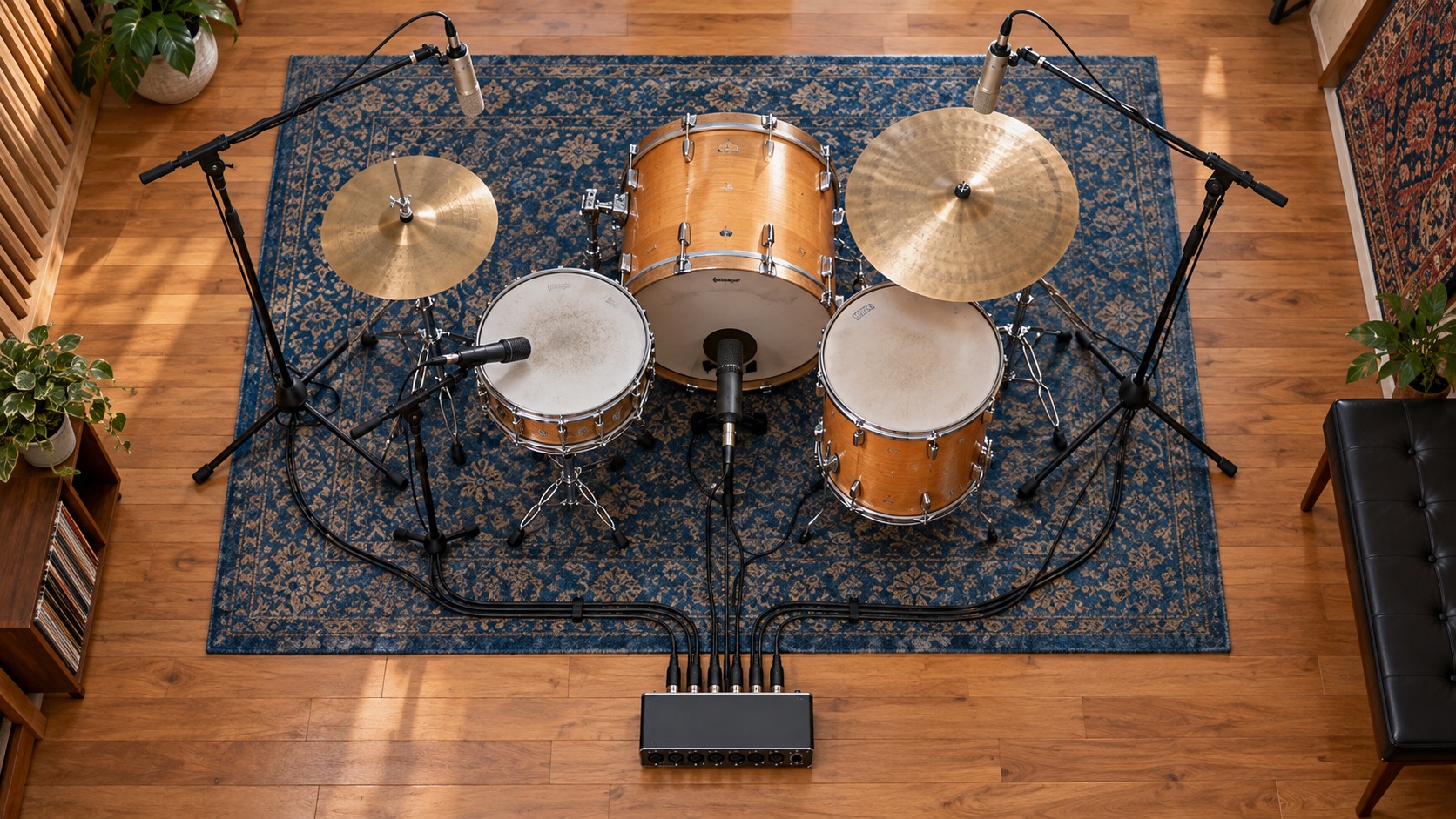
Two-mic drum recording is a legitimate approach, not just a budget compromise. Common layouts include a single overhead plus a kick mic, or a stereo pair over or in front of the kit. These setups suit demos, practice reviews and styles where a natural, roomy kit sound fits. The tradeoff is control. Balance happens at the microphone and in the playing, and you cannot raise the snare later without raising everything around it.
Multi-mic plans add separate tracks for kick, snare, toms, overheads and sometimes room mics. That gives you more control at the mix stage, but it also brings more setup time, more phase interaction between microphones, more stands and cables, and more decisions. A practical middle ground for many home setups is four channels: kick, snare and a pair of overheads. Whatever you choose, match the interface to the approach you will actually use, not the one in a professional studio video.
ADAT interface expansion and sample-rate limits
Many interfaces offer an optical input that can accept a separate eight-channel preamp unit using the ADAT format. ADAT interface expansion can be a sensible growth path. You buy a smaller interface now and add preamps later without replacing the main unit. Focusrite's guidance treats expansion as distinct from built-in preamps [S1], and buyers should do the same when comparing options.
The detail to check is how many channels the optical connection carries at the sample rate you intend to use. On many devices, optical channel counts fall at higher sample rates, but the exact behavior varies by model and generation. Confirm it in the manufacturer's manual for the precise model you are considering. Also confirm that the expansion unit can act as the clock source or follow the interface's clock, since mismatched clocking causes problems.
Stands, cables and cue monitoring belong in the budget
Every extra input you plan to use needs a microphone, a stand or clip, and a cable. Drum setups are hard on stands, because overheads need height and reach and kick and snare positions need low, stable placement. Budgeting for an eight-preamp interface and then running out of money for stands leaves inputs unused. Price the full chain for each channel you intend to use.
Cue monitoring is the other overlooked cost. Drummers need to hear a click and any backing tracks loudly and clearly over an acoustic kit, which often means isolating headphones. Check how many headphone outputs the interface has and whether each one gets its own level control or mix. If a second musician tracks at the same time, a single shared headphone output may not be enough. The manual should also state whether low-latency direct monitoring is available.
- One stand, mount or clip per mic position
- One cable per mic, plus spares
- Isolating headphones for the drummer
- Enough headphone outputs for everyone tracking
Hypothetical worked example
Hypothetical: a drummer owns two microphones and records practice takes at home. Their written plan is to add a kick mic within a few months and a snare mic later, with no other instruments tracked at the same time. Their firm requirement is three preamps, rising to four. A two-preamp interface covers today but not the plan. A four-preamp unit covers both stages. An interface with two preamps plus optical expansion could work, but only if they accept the cost of a separate expansion unit later.
Next, they check the details. They count their stands and find they need two more. They confirm the four-preamp candidate has an independent headphone level. They also verify on the manufacturer's site that the listing matches the current model generation. Because their plan stops at four mics, they decide an eight-preamp interface would mostly fund unused channels. This example is illustrative, not a recommendation of any product.
Red flags in listings and how to verify
Watch for listings that put a large combined channel count in the title without breaking down mic preamps. Be wary of used or marketplace units with no stated model generation, and of bundles that list accessories vaguely. Also be cautious with sellers who cannot confirm what is included. Older generations of the same product name can differ in preamp count, connections or driver support for current operating systems.
To verify, take the exact model name and generation and compare it against the manufacturer's current specifications and manual. For used units, ask for photos of the rear panel and the serial label, and check driver availability for your computer. Where the manufacturer offers product registration or a serial check, use it. Before paying, confirm the seller's return terms in writing.
When escalation makes sense
Contact the manufacturer's support team before buying if the manual is unclear about optical channel counts, clocking, or compatibility with your operating system and recording software. A written answer from the maker is more reliable than forum guesses, including anecdotes like the one cited above [R1].
Consider paying an experienced recording engineer for a short consultation, or booking a single studio session, if you are planning a large multi-mic setup. A professional can tell you whether your room and kit justify more microphones before you spend money on channels you may not need.
Your next steps
- Write a session plan listing every mic and source recorded at the same time
- Separate firm near-term additions from wishes and total the firm list
- Count built-in microphone preamps, not the headline channel number
- Confirm optical expansion channel counts at your intended sample rate in the manual
- Check clocking options if you plan an expansion unit
- Price stands, cables and headphones for every planned channel
- Verify headphone outputs and level controls for everyone tracking
- Match the exact model generation and driver support on the manufacturer's site
- Get return terms in writing before buying used or bundled gear
Questions that come up next
Is a two-input interface enough to record drums?
It can be, if you use a two-mic approach such as one overhead plus kick, or a stereo pair. You will have less control over individual drums at the mix stage. If you already know you will add a third microphone soon, a two-input unit may need replacing, as one Reddit anecdote describes.
What is the difference between mic preamps and inputs?
A mic preamp raises a microphone's weak signal to a usable level. Inputs is a broader term that may include line jacks, instrument jacks and digital channels. For drums, count the mic preamps. Line and digital inputs only help once you add external preamps or an expansion unit.
Should I buy the interface with the most inputs I can afford?
Not by default. More channels do not automatically improve drum recordings, and unused preamps take money away from microphones, stands and headphones. Buy enough preamps for your documented plan, and consider optical expansion as a growth path after confirming the exact model's limits.
Sources & further reading
Community discussions identify lived problems; they do not establish technical or legal requirements. Primary references support the specific claims cited above.
- R1 / COMMUNITY DISCUSSIONAudio interface on a budget ↗
- S1 / PRIMARY REFERENCEFocusrite: Choosing the Best Audio Interface for Your Needs ↗